The filament shelf is where beginner prints go to die — usually because the wrong plastic was chosen for the job. Here’s the honest comparison of the big three: how strong they really are, what heat and sunlight do to them, how forgiving they are to print, and which projects each one actually deserves.
Ask a room of printer owners which filament to start with and they’ll all say PLA, which is correct and also a little smug, because the real question comes one project later: “Okay, but what about this thing — the bracket for the grill, the hook in the shower, the part that sits in the sun?” That’s when the choice actually matters, and it’s where the internet’s advice gets fuzzy. So let’s be concrete. PLA, PETG, and ABS are the three plastics you’ll find in every maker’s drawer, and each one is good at exactly the things the other two are bad at.
All three melt and extrude through the same nozzles — that’s the whole point of fused filament fabrication — but they’re different polymers with different personalities. The chemistry shows up in your workshop as warping, stringing, layer strength, and whether your part sags into a pretzel on a summer dashboard. This guide covers the three plastics in depth, the specialty blends you’ll meet later, how to read a spool label, and the decision process that picks right the first time — because reprinting a failed part in the correct filament costs more time than choosing well ever does.
The Three-Minute Version
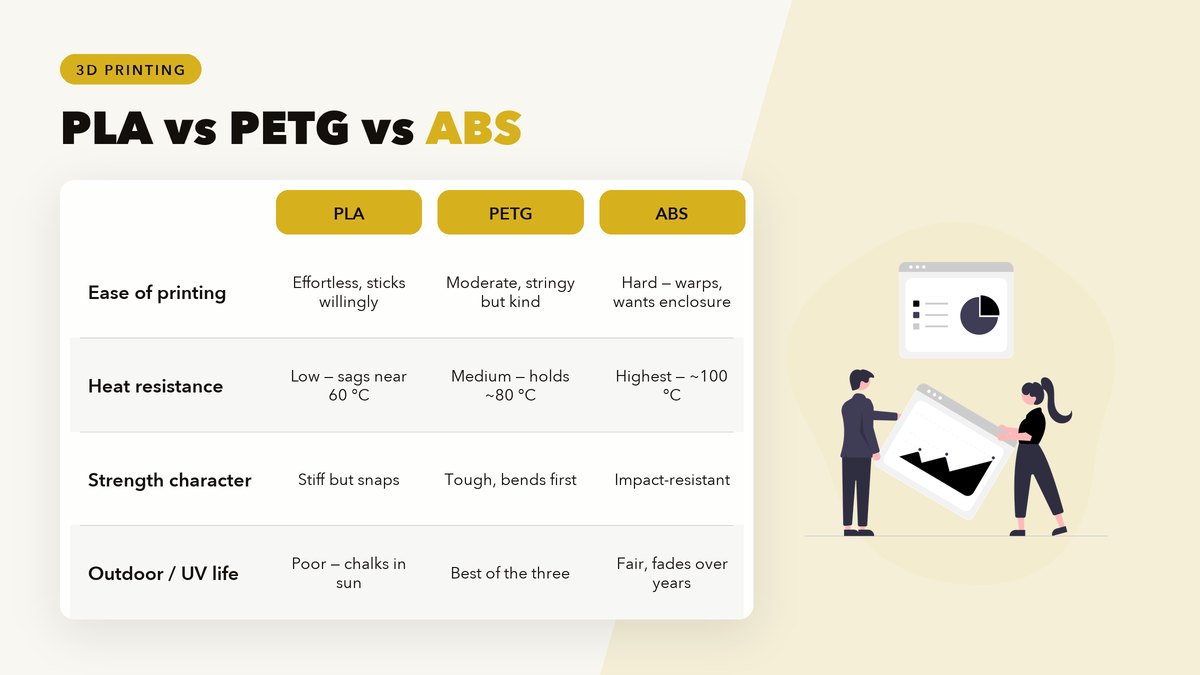
| PLA | PETG | ABS | |
|---|---|---|---|
| Easy to print | ★★★★★ (effortless) | ★★★☆☆ (stringy but manageable) | ★★☆☆☆ (warps, needs heat) |
| Strength | Stiff, brittle | Tough, flexes before breaking | Tough, impact-resistant |
| Heat resistance | Low (~60 °C sags) | Medium (~80 °C) | Highest of the three (~100 °C) |
| UV / outdoor use | Poor — gets brittle | Best of the three | Fair, fades and chalks |
| Smell while printing | Almost none | Mild, sweet | Noticeable styrene odor |
| Bed temp / enclosure | 0–60 °C, open air fine | 70–80 °C, open air fine | 90–110 °C, enclosure strongly recommended |
| Typical nozzle temp | 195–215 °C | 230–250 °C | 230–250 °C |
If you only remember one row, remember heat resistance. More failed prints trace back to “I used PLA for something warm” than to any slicer mistake.
PLA: The Beginner’s Plastic (For Good Reason)
Polylactic acid — corn-starch derived, the spool every printer ships with
PLA is polylactic acid, a bioplastic made from fermented plant starch, and it’s the default for structural reasons, not marketing ones. It sticks to the print bed willingly, barely warps, prints at low temperatures, and produces crisp detail without demanding an enclosure or special ventilation. For learning the machine — and for the majority of indoor, room-temperature projects — it’s simply the best tool.
Its weaknesses are equally clear once you know to look for them. PLA creeps under sustained load: a hook holding a heavy coat slowly bends over months. It softens in a hot car (a closed cabin on a summer afternoon cooks past PLA’s comfort zone easily), and prolonged sun exposure makes it chalky and brittle. Its maker NatureWorks publishes technical data sheets that spell out the glass-transition behavior, but the workshop translation is: indoors, light-duty, moderate temperatures — perfect. Heat, sun, or constant heavy load — pick something else.
PLA is also the most dimensionally friendly of the three. It shrinks very little as it cools, so parts come out closest to the designed size, and it sands, paints, and glues more easily than the others. For decorative work — cosplay props, planters, desk organizers, anything that lives a gentle life — it remains the right answer long after you’re no longer a beginner.
PETG: The Workshop Workhorse
Polyethylene terephthalate, glycol-modified — the water-bottle plastic, toughened for printing
PETG is a modified cousin of PET, the polyester in soda bottles, with glycol added to stop it from crystallizing and shattering. In printed form it sits in the sweet spot between PLA’s printability and ABS’s toughness: stronger and more heat-tolerant than PLA, far easier to print than ABS, and the best of the three for outdoor use because it shrugs off UV and water.
Its real-world strengths read like a list of workshop complaints about the other two plastics. Where PLA creeps under a steady load, PETG holds its shape for years. Where ABS demands a warm enclosure and careful ventilation, PETG prints happily on an open machine in a cool garage. And where both of them eventually embrittle outdoors, PETG keeps flexing through seasons of sun and rain — which is why the garden, the porch, and the truck bed quietly became its territory among owners who’ve compared all three side by side.
On the bench, PETG’s signature quirk is stringing. It melts sticky and oozes during travel moves, leaving fine hairs between parts of the model. The cure is the retraction tuning from your calibration routine — a little more retraction distance and slightly lower temperature than PLA — plus accepting that a quick pass with a heat gun or lighter flame tidies up stubborn wisps in seconds. PETG also bonds to print surfaces with startling stubbornness, so a thin layer of glue stick on the bed (counterintuitively, as a release agent) saves many a glass plate.
Reach for PETG when the part works for a living: brackets in the garage, planters on the porch, clips and jigs that get flexed hundreds of times, anything that sees weather. If a project leaves the house, PETG is usually the honest answer — and it’s become the default recommendation for exactly that reason among owners who’ve replaced a few sun-baked PLA parts.
ABS: The Old Guard, Still on Top for Heat
Acrylonitrile butadiene styrene — the LEGO plastic
Before PLA took over the beginner market, ABS was the default, and it earned the role: it’s the plastic in LEGO bricks, automotive trim, and drain pipe. It resists heat better than PLA or PETG, survives impacts that snap PLA, and can be smoothed with acetone vapor into a glossy, injection-molded finish no other filament matches.
The catch is that ABS is genuinely harder to print. It shrinks as it cools — a lot — so corners lift off the bed and long parts crack between layers unless the air around the print stays warm. That means an enclosure (even a cardboard box helps), a bed at 90–110 °C, and ideally a sticky print surface it can grip. It also emits a noticeable styrene smell while printing; the RepRap project’s long-running ABS material page covers both the handling benefits and the ventilation question, and the honest guidance is: print it in a ventilated space, not the bedroom office. For most hobbyists, PETG now covers 90% of what ABS used to be chosen for — but for parts that live near real heat, like a replacement dishwasher wheel or an engine-bay clip, ABS still wins.
There’s also a finishing superpower worth mentioning: acetone vapor smoothing. Ten minutes of gentle acetone vapor melts the layer lines off an ABS part, leaving a glossy surface that fools people into thinking it came from an injection mold. PLA can’t do this at all, and PETG resists most solvents, so if post-processing aesthetics matter — props, enclosures, gifts — ABS keeps a genuine edge. Sand, prime, paint: ABS takes all three beautifully, which is why the cosplay and prop-making world never stopped using it even as the rest of us moved to PLA and PETG.
How to Actually Choose
Forget the properties for a second and run the decision the way experienced owners do — by asking about the part’s life:
- Does it live indoors at room temperature and mostly hold still? PLA. Easy print, great looks, no drama.
- Does it flex, live outdoors, or get wet? PETG. Toughness and weather resistance are its whole job.
- Will it see real heat — a car, an appliance, a motor? ABS, printed warm and ventilated. Check the numbers against the materials guidance in Prusa’s official docs if you’re on the edge.
- Are you still learning the machine? PLA, unambiguously. Master the printer’s behavior on the most forgiving plastic before asking a harder one to behave.
Two practical footnotes. First, brand matters more than the marketing suggests — cheap filament with inconsistent diameter turns good settings into bad prints, so a mid-priced spool from an established brand is the cheapest upgrade in the hobby. Second, keep at least two of the three on hand; half the “which filament” question disappears the moment you can just reach for the right one instead of forcing the loaded spool to be something it isn’t.
PLA’s Quirks, Honestly Told
Because PLA is the first plastic most people print, its quirks get mistaken for printer problems — so let’s name them up front. PLA loves to string a little at high temperatures, and its overhangs droop sooner than PETG’s because it stays soft briefly after leaving the nozzle. Cooling is the fix for both: make sure the part-cooling fan actually runs (it’s the single most under-appreciated component on a beginner printer), drop the nozzle temperature toward the low end of the spool’s range, and overhangs snap into focus.
PLA also fails differently than the other two, and knowing the failure mode matters. PETG and ABS usually bend or tear when overloaded; PLA snaps, often with almost no warning. A PLA hook that has crept under load for a month lets go all at once at 2 a.m., scattering tools across the garage floor. That doesn’t make PLA bad — it makes it a material whose limits you design around: thicker sections, gentler loads, or simply the right plastic for the job two feet to the left on the same shelf.
Beyond the Big Three
Once the big three feel familiar, the rest of the spool wall starts making sense, because everything there is a variation on these personalities:
- PLA+ (or “tough PLA”): Additives push PLA’s impact strength up noticeably while keeping its easy printing. The most common “upgrade” spool, and genuinely useful — though it’s still PLA where heat is concerned, so dashboard-duty remains off the table.
- ASA: ABS’s modern sibling. Prints like ABS but shrugs off UV, which is why it’s the go-to for anything that lives outdoors in the sun for years — garden gear, antenna mounts, RV parts. Needs an enclosure just like ABS.
- TPU: Flexible, rubbery, and enormously fun — phone cases, drone bumpers, belt drive belts. Prints slowly on direct-drive machines and teaches patience everywhere else.
- Filled filaments (wood, carbon, glow): Wood-filled PLA sands and stains like real timber and glow filaments are pure joy for kids’ projects. Know that abrasive fillers wear standard brass nozzles; a cheap hardened-steel nozzle pays for itself.
None of these are beginner materials, but they’re beginner-understandable: each one is “one of the big three, with a twist.” When a project eventually demands one, you’ll recognize the twist immediately.
Reading a Spool Label Like a Pro
Every respectable spool prints the numbers that matter right on the sticker, and thirty seconds with it prevents most bad prints:
- Nozzle temperature range (e.g. 230–250 °C): start at the middle, tune down for detail and up for layer strength. When a print strings, the label’s low end is the first place to go.
- Bed temperature: PETG likes a genuinely warm bed around 70–80 °C; a lukewarm bed is the most common reason PETG parts pop loose mid-print.
- Diameter and tolerance: 1.75 mm is the standard; ±0.03 mm tolerance marks quality filament, while sloppy diameter shows up as random bands of over- and under-extrusion that no setting fixes.
- Density / weight: matters only for cost comparisons — a “1 kg” spool that’s mostly cheap filler weighs the same as a dense one but prints less. Established brands list the math.
Finally, note the color batch. Pigment changes how a given polymer prints — black PLA and white PLA from the same brand can prefer temperatures 10 °C apart — so when you open a new color, expect to re-run a quick temperature check rather than trusting the old profile blindly.
Five Projects, Five Honest Picks
Theory is cheap; here’s how the choice plays out on real workshop projects:
- A desk organizer for the office: PLA. It never leaves climate control, holds nothing heavier than pens, and PLA’s crisp detail makes the dividers look sharp. This is 70% of everything you print for the first year.
- Hooks for garden tools on the fence: PETG. Rain, frost, and summer sun all hit that fence, and PETG takes the weather year after year where PLA would chalk and snap by autumn.
- A replacement clip inside a dishwasher: ABS. Steam and 60-plus-degree water are exactly the conditions that soften PLA and stress PETG over time; ABS was born for appliance interiors.
- A jig that gets clamped, dropped, and flexed daily: PETG. Workshop jigs live a rough life, and PETG’s habit of bending before breaking survives the abuse that makes brittle plastics fail in a week.
- A decorative vase or planter for the shelf: PLA, printed in vase mode, and sealed on the inside if it’s meant to hold water. Gorgeous, easy, and nobody’s dashboard is involved.
Notice the pattern: the failures people complain about online almost always come from one of these slots filled with the wrong row of the table — the PLA car part, the outdoor hook in plain PLA, the ABS print attempted on a cold open printer with no enclosure. Choose by the project’s life, not by what’s on the spool holder, and most of the horror stories never happen to you.
The Verdict
PLA is where you start and where decorative things stay. PETG is where functional, outdoor, and load-bearing things should live for most hobbyists. ABS keeps its throne for genuine heat but asks for an enclosure and ventilation in return. Master those three personalities and you can print confidently for years — and when a project demands something exotic like flexible TPU or carbon-filled nylon later, you’ll already have the judgment to handle them.
If you’re standing in front of the spool wall right now with one project in hand, here’s the whole decision in one breath: print it in PLA unless it leaves the house, flexes under load, or gets warm — and let those three exceptions send you to PETG or ABS. That single rule has quietly resolved the filament question for thousands of owners before you, and it will carry you until the day a project finally earns a spool from the exotic shelf.
External references checked October 2026: Wikipedia entries on fused filament fabrication, polylactic acid, polyethylene terephthalate, and acrylonitrile butadiene styrene; NatureWorks (PLA manufacturer); the RepRap project’s ABS material page; and Prusa’s official support portal. Also in this series: first-printer setup, the calibration checklist, and symptom-by-symptom troubleshooting.
Leave a Reply