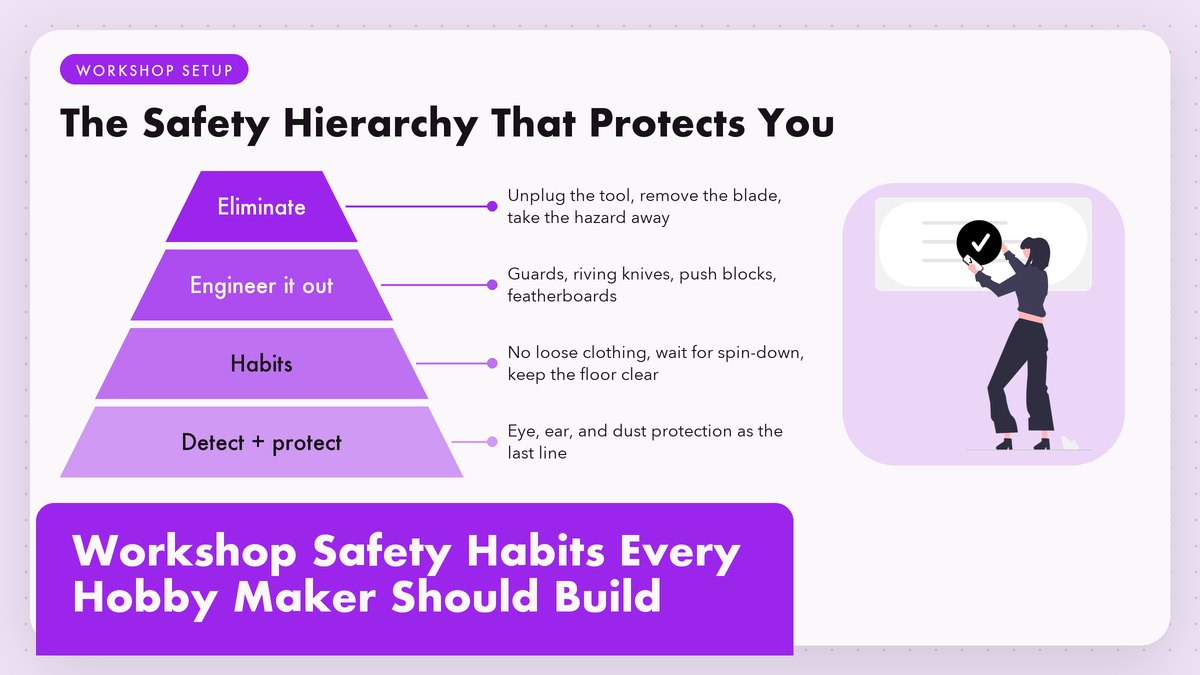
Workshop accidents rarely look dramatic. A board jumps, a fingertip brushes a cutter, the room fills with dust for the thousandth time, and the damage is done before you finish blinking. This is a practical guide to the four causes that actually hurt hobby makers — kickback, blade contact, dust, and noise — and the cheap habits and gear that prevent them without turning your shop into a padded cell.
The closest I’ve come to a bad shop injury didn’t look dramatic at the time. I was ripping a thin strip of pine on the table saw, the offcut was maybe an inch and a half wide, and instead of grabbing the push stick that was resting on the fence right in front of me, I finished the cut with my fingertips because it was the last board of the evening and I wanted to be done. The strip caught between the blade and the fence, kicked back, and buried itself in the drywall behind me with a sound like a bat cracking. My hand was fine, the board left a dent I can still point at, and that dent is the whole reason this article exists.
What I’ve figured out since, from that dent and from reading accident accounts until the patterns got almost boring, is that hobby shop injuries almost never match the movie version. Nobody screams, nothing happens in slow motion, and the saw doesn’t suddenly grow a mind of its own. A workpiece jumps a fraction of a second after the cut felt perfectly normal, or damage piles up silently over years of evenings that each seemed harmless. The causes behind it all turn out to be a short list that repeats across nearly every report you’ll ever read. Kickback. Blade contact. Dust. Noise.
Four causes. The good news buried in that list is that none of the protections cost much, and none of them will make your shop less fun. Most aren’t even gear. They’re habits, and habits are free.
None of this requires heroism, either. You don’t need a course certificate or a padded shop or a supervisor looking over your shoulder, and if you build even half of what’s below, you’ll be safer than most commercial shops were a generation ago.
In this article
- The Four Causes That Actually Send Makers to the ER
- Kickback, the Table Saw’s One Dirty Trick
- Blade Contact and the Guard You Took Off
- Dust, the Slow Injury Nobody Wants to Think About
- Noise, the Sneakier Slow Injury
- Eyes, Gloves, and the Small Decisions
- The Habits That Do the Actual Work
- Fire and Electricity, the Boring Killers
- Building the Habits Without Losing the Fun
The Four Causes That Actually Send Makers to the ER
Acute injuries and slow ones — the list is shorter than you’d guess
Spend an hour with the safety material published by the Power Tool Institute, an industry group funded by the major tool manufacturers, and the same few failure modes keep surfacing. Two of them are fast and violent, kickback and direct blade contact, and they send people to the emergency room on a Saturday night. The other two are slow and quiet, wood dust in your lungs and noise in your ears, and those show up decades later as a chronic cough, a ringing that never stops, or a hearing test that goes badly.
Every section below picks apart one cause, explains the physics or the biology honestly, and then hands you the habit that neutralizes it. Also, you can read them in any order you like. But read the table near the end, because it’s the whole article condensed onto one screen, and it’s what I’d want taped inside your shop door.
Kickback, the Table Saw’s One Dirty Trick
Kickback is simple physics wearing a scary costume. When a board being ripped pinches the back of the blade, which happens the moment the wood relaxes against the fence, closes its own kerf, or twists under your push, the teeth at the rear of the spinning blade catch the wood and lift it. Then they throw it. Back toward you, at a speed that commonly tops a hundred miles an hour, from maybe two feet away. A two-pound offcut arriving that fast carries enough energy to break ribs, and it doesn’t care what’s in the way, which is usually your torso or your face since that’s where people naturally stand.
The triggers are predictable. Ripping narrow strips is the big one, because a thin offcut flexes and binds with almost no provocation. Sawing warped lumber or wood with internal stress causes the same trouble, since the board closes up around the blade the instant you cut it free. A fence even slightly out of parallel with the blade squeezes the work harder the deeper it travels, and a missing splitter or riving knife removes your main defense entirely. That little fin of metal riding just behind the blade is what keeps the kerf open so the wood can’t grab. OSHA’s machine guarding guidance is written for workplaces, but the physics it describes is identical in a garage, and it’s worth ten minutes of your time.
My rule after the drywall incident is blunt. If the offcut is narrower than about three inches, the push stick finishes the cut, every time, with no exceptions for “just this one board.” Push sticks cost nothing. Saw one out of half-inch plywood in five minutes, round over the handle, and make three of them so one is always within reach, because a push stick that’s across the shop might as well not exist. Stand slightly to the side of the blade’s line as well, never directly behind the workpiece. That single positional habit turns the worst kickback into another hole in the wall.
Blade Contact and the Guard You Took Off
Nearly every blade-contact story, including the near-misses people trade at club meetings, shares one detail. The cut was routine. Nobody cuts a familiar board on a familiar saw expecting to get hurt, and that’s exactly the problem, because attention drifts on the five hundredth rip in a way it never does on the first. Plenty of table saw hand injuries also happen within an inch of the blade, at the very end of a cut, where fingers replace the push stick they should have grabbed. Ring a bell? It should.
Two hardware fixes matter more than everything else here. Keep the riving knife installed, always, because it prevents the kickback that throws your hands toward the blade in the first place. And stop removing the blade guard. Guards earned a bad reputation because the cheap ones of decades past were genuinely obstructive, but modern guards with anti-kickback pawls and a dust port are nothing like those clunky plastic coffins, and the guard doubles as your best fine-dust pickup point at the saw. OSHA’s woodworking machinery page covers guarding, featherboards, and safe body position in plain language, and the habits translate straight to a home shop.
The habit that took me years to internalize is the simplest one on this page. Never reach over a spinning blade to clear an offcut or line up the next piece. Spin-down is not safety, and a blade below the table surface will still open your hand. Turn the saw off, count to three, and only then move your hands where they need to go. Those three seconds are the cheapest insurance in the entire hobby.
One honest note about the saws with flesh-sensing brakes, the ones that stop the blade within a few milliseconds of touching skin. They’re expensive, the brake cartridge is a consumable, and they’ll trip on wet or pressure-treated lumber at the worst possible moment. They’ve also saved a lot of fingers, and if you’re buying a new saw with room in the budget, I’d argue they’re worth a hard look. Just don’t treat one as a substitute for everything else in this article, because most kickback injuries involve a board hitting you, and no brake stops a flying two-by-four.
Dust, the Slow Injury Nobody Wants to Think About
Sawdust feels harmless. It piles up under the saw, it smells like the project, and sweeping it up feels like tidying rather than hazard control. Wood dust, though, splits into two very different things. Chips and shavings are the visible fraction, the stuff a dust collector or shop vac handles happily. Fine dust is the sneaky one. Particles below roughly ten microns, a fraction of the width of a human hair, stay airborne for ages, drift past your nose, and settle deep in your lungs instead of in the broom pile. Sanding is the worst offender by far, followed by any cut on a miter saw, where the blade throws a rooster tail of fine dust straight into your breathing zone.
The health picture here is genuine and backed by decades of occupational data. OSHA’s wood dust page lays out the respiratory risks, and woodworkers develop real sensitization to certain species, western red cedar being notorious, where repeated exposure flips a switch and your airways start reacting to even small doses. The last part deserves emphasis, because it changed my behavior. Sensitization doesn’t heal. Once you’ve reacted, you’re done with that wood for life, and a few people in my local club can’t go near oak anymore, which is a miserable sentence for a woodworker.
Defense works in layers. Collect at the source wherever the tool allows it, meaning the blade guard port on the table saw, a hose on the sander, and a hood behind the miter saw. Capture the chips with a shop vac or dust collector, then run a room air filter for the fine fraction the hose misses. After that, wear a P100 respirator for sanding regardless of how quick the pass will be, because “quick” adds up across a hundred evenings. I resisted the respirator for years, to be honest. Then I blew my nose after a sanding session without one, saw the evidence, and stopped resisting that same week.
Noise, the Sneakier Slow Injury
Noise damage is dust damage’s quieter sibling, and it has one trait that makes it arguably worse. You can’t feel it happening. A table saw runs around 100 decibels, a thickness planer hits 100 to 105, a handheld router can reach 110, and a shop vacuum sits somewhere around 85 to 90, which matters because you stand beside that one for hours at a stretch. The math of decibels is the part that surprises people. Every increase of 3 dB doubles the sound energy, so a tool at 103 dB does as much damage in half the time as one at 100. Push the level up twenty decibels and your safe exposure window shrinks from a workday to a handful of minutes. Double the energy, half the time. That’s the whole rule.
What makes this insidious for hobbyists is the evening pattern. Professional shops monitor noise and rotate workers between loud and quiet tasks. You run the planer for an hour at 9 pm on a Tuesday, then again Thursday, for years, with nobody measuring anything. The National Institute on Deafness and Other Communication Disorders explains the mechanics of noise-induced hearing loss in plain terms, and the short version is unsettling. The hair cells in your inner ear that turn vibration into sound die off from exposure, and they don’t regenerate. Tinnitus, that ringing after a loud session, is those cells waving a white flag. MedlinePlus’s overview of hearing disorders and deafness shows what cumulative loss looks like across a lifetime, and it reads differently once you’ve owned a planer for a few years.
The gear side is easy. Foam earplugs cost pennies and block 25 to 33 dB depending on fit, while over-ear muffs run 25 to 30 dB and beat plugs for comfort over a long session, since you can slip them on and off a hundred times without touching anything that goes inside your ear canal. (I buy the plain foam cylinders in bulk bags and lose them constantly, which is fine at that price.) For the loud, sustained offenders — planer, jointer, router table — wear both at once, because plugs plus muffs stack meaningfully rather than simply adding their ratings together. My entire system is one hook screwed into the wall beside the shop door.
Protection that lives in a drawer doesn’t exist when the planer is running.
Eyes, Gloves, and the Small Decisions
Eye protection has the best cost-to-benefit ratio in any shop. Safety glasses come in comfortable, fog-resistant, ten-dollar versions now, and they should be on your face for every single spinning or striking operation, which in practice means drilling, routing, sanding, cutting metal, and striking chisels. The American Academy of Ophthalmology reports millions of eye injuries every year in the United States and stresses that the overwhelming majority are preventable with protective eyewear. For turning on a lathe or using an angle grinder, wear a face shield over the glasses, because grinding wheels and chucks throw debris at your face from angles glasses don’t cover.
Gloves are the counterintuitive one, and this trips up almost everyone who arrives at the shop from gardening or auto work. Never wear gloves near anything that rotates. Drill press, lathe, table saw, router table, even a handheld drill in certain grips. A glove gives a spinning machine something to grab, and a glove caught on a chuck converts a harmless nick into a mangled hand as the machine winds the fabric in. Gloves are for handling rough lumber, sheet goods with sharp edges, and splintery reclaimed wood, and that’s the whole list. The same logic covers rings, dangling drawstrings, untied long hair, and loose sleeves. None of it matters until it matters enormously.
Two more small ones that cost nothing. Wear closed shoes, since a board knocked off the bench lands on feet first, and keep the floor path between you and the door clear of cords, offcuts, and roller stands, because when something goes wrong you’ll want to move fast without a second thought about what’s underfoot.
The Habits That Do the Actual Work
Willpower is a terrible safety system, since it runs out at exactly the wrong moment, like at the end of an evening when you’re tired and one board short of done. What works instead is installing a few small habits so the safe choice becomes the default choice. This table is the whole article on one screen. Steal it:
| Habit | What it prevents | What it costs you |
|---|---|---|
| 30-second walkaround before power-on: cords clear, guards in place, wrenches off the arbor, floor swept | Most “I forgot” accidents of every kind | 30 seconds per session |
| Push stick finishes any rip narrower than ~3 inches | Kickback hits and end-of-cut blade contact | Free, plus five minutes to saw one from scrap plywood |
| Unplug before blade changes, bit changes, or freeing a jam | The worst category of table saw and router contact injuries | About 5 seconds |
| Riving knife installed and checked before every session | Kickback at the source | 10 seconds |
| Hearing muffs live on a hook by the door; plugs for the loud machines | Cumulative hearing loss and tinnitus | $20-30, once |
| P100 respirator for sanding, no matter how quick | Fine-dust sensitization and lung irritation | A few cents per wear |
| Oily finish rags go in a metal can or get laid flat outdoors to dry | Spontaneous combustion fires | An old coffee tin |
Add up the right-hand column and the whole system costs you maybe two minutes per shop session, though I’d bet some evenings it’s closer to one. That’s less time than you spend hunting for a pencil or your tape measure, and it’s a rounding error next to an evening in an emergency room.
Fire and Electricity, the Boring Killers
Shop fires are rare but ugly, and the most famous cause is one hobbyists create constantly. Oily finishing rags. Rags soaked in linseed oil or oil-based finish dry by oxidizing, and oxidation gives off heat. Wad a pile into a corner and the heat has nowhere to go, which is how garages light themselves up hours after the woodworker has gone to bed. The fix is absurdly simple. Store oily rags in a lidded metal can, or lay them flat in a single layer outside until they’re stiff and dry. The U.S. Fire Administration’s home fire prevention page covers this and the other slow-burn household fire starters in plain terms. Fine dust plays a role here too, since a thick dust layer around a grinder’s sparks is a real ignition risk, which is one more quiet argument for keeping collection working.
Keep an ABC-rated fire extinguisher within about ten feet of the shop entrance, mounted on the wall where your hand finds it in the dark, and glance at the pressure gauge whenever you change the clock batteries. On the electrical side, ground-fault protection matters more in a shop than anywhere else in the house because concrete floors and grounded metal machines conspire against you, so use GFCI outlets or adapters and resist the urge to run the dust collector, the shop vacuum, and a space heater from one power strip. The NFPA’s fire extinguisher guidance is short, readable, and worth five minutes before you buy one.
Building the Habits Without Losing the Fun
The usual failure mode of shop safety advice is that it reads like a list of things you may no longer do, and a shop full of forbidden moves is a shop you eventually stop entering. The answer, at least in my shop, is to think in terms of friction instead of rules. Every habit above becomes permanent once the safe option is also the easy option. Muffs on a hook by the door beat muffs in a drawer. Three push sticks taped near the saw beat one that lives on a shelf. A respirator hanging off the sander gets worn, while one in a cabinet gets ignored. You’re not disciplining yourself into safety. You’re rearranging the room so the safe thing happens on its own.
Start this weekend with a single change, because the whole list at once is how none of it sticks. Saw a push stick, or screw in the hook for the muffs, or walk the shop with the table above and check off the boxes you can’t honestly claim yet. The dent in my wall stays right where it is, because it reminds me of the last board of an evening better than any warning sign I could hang.
Sources & references: OSHA’s woodworking machinery and wood dust pages, the Power Tool Institute’s safety material, the U.S. Fire Administration, the NFPA, the NIDCD and MedlinePlus on hearing loss, and the American Academy of Ophthalmology on eye injuries, all linked above. Related reads on this site: your first woodworking projects, the essential beginner tool kit, finishing wood projects safely, and soldering safety and technique. Updated October 2026.